How to Plan Your Wedding Tent Rental Budget
Last Updated: October 25, 2026
Quick Summary
Wedding tent rental cost depends on tent size, duration, add-ons, delivery distance, and seasonal demand. Most couples find the final price differs from their initial quote because they didn't account for setup, labor, or ancillary rentals like tables and chairs.
- A 20-by-40-foot frame tent accommodates roughly 40-50 guests for a seated dinner, while a 40-by-60-foot tent handles 150-200 guests.
- Most rental companies charge delivery, setup, and labor separately from the tent structure itself, so comparing quotes requires careful attention to what's included.
- A 100-guest wedding requires a tent in the 30-by-50-foot to 40-by-40-foot range, approximately 1,200-1,500 square feet minimum.
- Flooring, lighting, sidewalls, heating, and cooling are almost always add-ons that increase your total wedding tent rental cost.
- Send a standardized comparison checklist to every provider so each quote answers the same questions and you can compare all-in totals fairly.
Table of Contents
- Understanding Wedding Tent Rental Cost Basics
- Tent Size and Guest Capacity: How They Drive Pricing
- Wedding Tent Rental Packages and What's Included
- Planning a Tent Rental for 100 Guests
- Hidden Costs: Delivery, Setup, and Labor Fees
- Getting Wedding Tent Rental Quote Comparisons
- Booking Your Tent Rental with No Wait Party Supply
- Frequently Asked Questions
Understanding Wedding Tent Rental Cost Basics
A wedding tent rental cost depends on tent size, duration, add-ons, delivery distance, and seasonal demand. Most couples find the final price differs from their initial quote because they didn't account for setup, labor, or ancillary rentals like tables and chairs.
The wedding tent rental cost you'll encounter typically includes the tent structure itself, but often excludes installation and takedown. Understanding this distinction upfront prevents budget surprises. At No Wait Party Supply, we help couples break down exactly what they're paying for.
When you research a wedding tent rental cost near me, you're really shopping for three things: the tent, the labor to install it, and add-on equipment. Most companies price these separately, so comparing quotes requires careful attention to what's included.
Tent Size and Guest Capacity: How They Drive Pricing
Tent size is the primary driver of wedding tent rental cost. A 20-by-40-foot frame tent accommodates roughly 40-50 guests for a seated dinner. A 40-by-60-foot tent handles 150-200 guests. The relationship between square footage and price is direct: double the size, roughly double the cost.
Guest capacity determines tent size, which determines your budget. If you're inviting 100 guests but haven't selected a tent size, you're guessing at your wedding tent rental cost. Measure your guest count first, then work backward to tent dimensions.
Tent style affects pricing. A pole tent costs less than a high-peak tent because installation is simpler, while a clear-span frame tent commands more due to structural complexity and its premium look. Your choice of style directly impacts your wedding tent rental cost.
Ground conditions matter more than most couples realize. A flat, level backyard costs nothing to prepare, but a sloped yard, gravel surface, or area with underground utilities requires site prep that adds to your total wedding tent rental cost. Ask about site assessment fees upfront.
Wedding Tent Rental Packages and What's Included
Most rental companies offer tiered wedding tent rental packages. A basic package includes the tent structure, delivery, and setup. Mid-tier packages add flooring, lighting, or sidewalls.
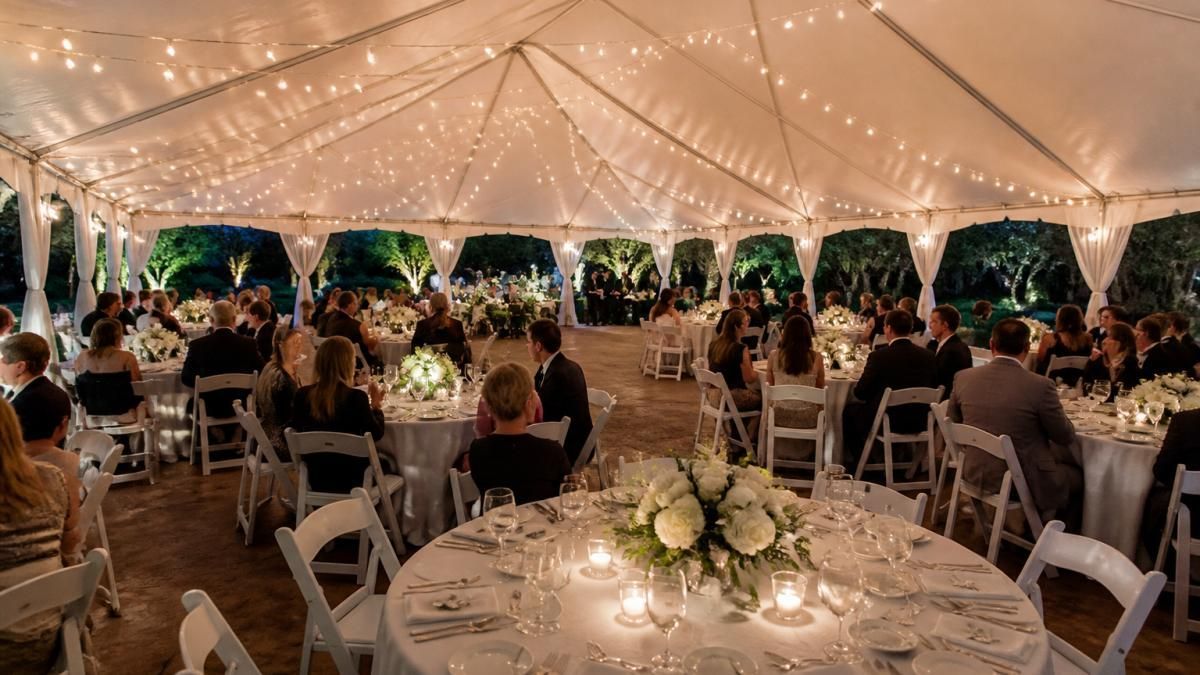
When comparing wedding tent rental packages, read the fine print. One company's "complete package" might exclude labor while another includes it, and a cheaper package often omits something critical.
Flooring is rarely included in basic packages, yet most couples need it: it protects grass, provides a stable surface, and keeps guests' shoes clean.
When you're comparing packages, ask what happens if weather turns bad. Does the rental company provide sidewalls at no extra charge, or is that an upsell? A rain plan isn't optional, it's essential.
Heating and cooling affect your wedding tent rental cost. Summer events might need cooling fans or AC units; winter events require heaters. In extreme weather these aren't luxuries but necessities that keep guests comfortable.
Planning a Tent Rental for 100 Guests
A 100-guest wedding requires a tent in the 30-by-50-foot to 40-by-40-foot range, depending on whether you're doing a cocktail reception or a seated dinner. Cocktail-style events pack more people into less space. Seated dinners need roughly 12-15 square feet per guest.
Table and chair rentals become critical at this guest count. A tent rental for 100 guests almost always requires them as add-ons: most couples need 8-12 round tables or 4-6 rectangular tables, plus 100 chairs.
Catering logistics matter for a tent rental for 100 guests. Your rental company needs to know if you're using an outside caterer, as this affects where the caterer sets up, whether you need a catering tent, and what electrical or water access you'll require.
Parking and guest flow are overlooked but essential for a tent rental for 100 guests. With 100 people arriving at once, you need adequate parking and a clear path to the tent; otherwise guests park on the street, creating liability issues.
Hidden Costs: Delivery, Setup, and Labor Fees
Headline tent prices are almost never the number you pay. The gap between a quoted rate and your invoice comes from delivery, labor, site prep, utilities, permits, and taxes.
Here is how each line item typically works and how to budget for it.
Delivery and pickup. Most companies charge a flat delivery fee plus a per-mile surcharge beyond a local radius.
Setup and teardown labor. Labor is usually quoted per crew member per hour, and the crew size scales with tent size.
Site preparation. Level ground is free. Sloped terrain, gravel, asphalt, or turf that needs protection adds labor and materials.
Power and utilities. If your caterer needs warming equipment, lighting, or a handwashing station, the tent may need a generator or a dedicated power drop.
Taxes and fees. Sales tax applies to rental equipment in most states, and some companies add administrative or damage-waiver fees. These are small percentages individually but compound across the whole order.
For a mid-size seated wedding, the tent itself is often the smallest share of the all-in cost once delivery, labor, flooring, lighting, tables, chairs, power, permits, and tax are counted. Comparing a tent rental to a traditional venue on headline price alone is misleading: the venue quote bundles many of these items, while the tent quote often does not. Put both on the same itemized worksheet and the comparison becomes honest.
Wedding tent costs extend far beyond the tent itself; here are the major line items that typically appear on your final invoice.
| Cost Item | What It Covers | Notes |
|---|---|---|
| Delivery and pickup | Transport to and from site | Base fee plus per-mile surcharge beyond local radius |
| Setup and teardown labor | Crew installation and removal | Crew size and hours scale with tent size and style |
| Site preparation | Ground leveling and protection | Sloped, gravel, or paved surfaces incur extra charges |
| Power and utilities | Generator, electrical hookup, water | Required for catering equipment, lighting, handwashing |
| Permits and insurance | Event permits and certificates | Requirements vary by jurisdiction and venue |
| Taxes and fees | Sales tax and administrative charges | Applied to rental equipment in most states |
Getting Wedding Tent Rental Quote Comparisons
Quotes from different rental companies are rarely apples to apples. One includes labor, another excludes it; one assumes a one-day rental, another prices a weekend; one bundles sidewalls, another treats them as an upsell.
Send this checklist with your request for quote:
- Tent specification: size in feet, style (pole, frame, clear-span, high-peak), and whether sidewalls are included.
- Capacity assumption: seated dinner versus cocktail style, and the guest count the provider sized the tent for.
- Rental duration: number of days the tent stays up, and whether delivery, setup, and teardown days count toward the rental period.
- Delivery: base fee, per-mile surcharge, distance from their yard to your site, and whether pickup is a separate charge.
- Labor: crew size, estimated install and strike hours, and whether labor is inside the package or billed separately.
- Site prep: what the provider assumes about ground conditions and what prep would add if the site is sloped, gravel, or paved.
- Add-ons: flooring, lighting, heating or cooling, tables, chairs, linens, dance floor, and power or generator, each with its own price.
- Permits and insurance: which permits the provider handles, which you must obtain, and whether a certificate of insurance is available.
- Fees and tax: administrative fees, damage waiver, sales tax rate applied, and any weekend or holiday surcharge.
- Weather and cancellation: sidewall policy if weather turns, reschedule terms, and refund policy.
Once every provider answers the same checklist, score each quote on two axes: total all-in price and inclusions. A quote that is higher on the tent line but includes labor, sidewalls, and flooring can be the cheaper option once the worksheet is complete. Compare the all-in total, not the headline.
Ask each provider about setup timelines and weekend availability. Some install the morning of the event; others require the day before, which affects rental duration and price. Peak-season dates can carry premium rates, so confirm the quoted price holds for your date.
Responsiveness is part of the comparison. Call each company with a follow-up question and note how quickly and clearly they answer. A provider with a slightly higher all-in total but reliable communication and a written weather plan often beats the lowest bid.
Finally, ask about cancellation and rescheduling in writing. Weather postponements and personal circumstances happen, and the refund and reschedule terms matter as much as the price when you are committing months in advance.
Contact tent rentals in your area to see current availability and pricing for your date and location. No Wait Party Supply offers party supply pricing and package deals that bundle tent rentals with tables and chairs, and we will complete the same comparison checklist for your quote so you can rank options on equal terms. When you are ready for formal quotes, reach out to compare options.
Booking Your Tent Rental with No Wait Party Supply
No Wait Party Supply handles wedding tent rentals across the greater Washington, D.C. area with professional delivery, setup, and teardown. Our team manages the logistics so you can focus on your celebration.
We offer military, educator, and first responder discounts, 10% off your total rental. If you fall into any of these categories, bring valid ID when finalizing your booking and we'll apply the discount immediately.
Our booking process is straightforward. Contact us to discuss your specific event, and we'll provide a detailed quote that breaks down every cost. No surprises. No hidden fees. Just transparent pricing and professional service.
When you book with No Wait Party Supply, you're partnering with a team that cares about your event's success.
Planning your wedding tent rental budget doesn't have to feel overwhelming. Break it into components: tent size and style, add-ons like flooring and lighting, labor and delivery, and contingency for weather protection.
Frequently Asked Questions
How much does it cost to rent a tent for 100 wedding guests?
Pricing for a tent rental for 100 guests depends on tent style, rental period, delivery location, and add-ons like flooring and lighting. Frame tents and pole tents are common choices for this capacity. Request a quote from your local rental provider to get an accurate estimate based on your specific event details, date, and setup requirements.
What factors affect wedding tent rental cost the most?
The primary cost drivers are tent size (measured in square footage), rental duration (day of event versus multi-day), tent style (frame, pole, or high-peak), seasonal demand, delivery distance, setup complexity, ground conditions, and add-on rentals such as flooring, lighting, tables, and chairs. Weekend and peak-season events typically cost more than weekday or off-season dates.
Do wedding tent rental packages include delivery and setup?
Most wedding tent rental packages include professional delivery and setup, but this varies by provider and package tier. Some providers bundle these services; others charge them separately as labor fees. Always confirm what's included in your rental package before signing. Ask specifically about teardown, site preparation, and whether delivery covers your exact location.
How far in advance should I book a wedding tent rental?
Book your wedding tent rental 2-3 months in advance for peak season (May through October) to secure your preferred date and tent style. For off-season events or short-notice needs, some providers offer availability with less lead time. Contact your rental company early to discuss your event date, guest count, and any special requirements or constraints at your venue.